
An Introduction To The Enneagram Via a Story of Entering Junior High School
What if the seat you chose on the first day of junior high says more than you know about the person you believe to be?

In 6th grade, my last year of elementary school, we would start to hear from those in Junior High about the different opportunities and challenges that came from entering these two awkward transition years between grade school and high school. One thing that aroused our excitement was knowing that in Junior High, you no longer were assigned seats in your classrooms. After spending the last 7 years confined to the same desk, this was a glimpse of freedom, an acknowledgement of individuation! Such a small thing, but knowing I can change seats from one day to the next felt extremely liberating to me and my peers.
First day of Junior High, we walked into the classroom and the invitation was open: sit wherever you want. No name tags on desks. No seating chart. Freedom!
Several months passed and I noticed that we were all sitting in the same seats we chose on the first day of class. Somehow at age 13 this was perhaps my first conscious glimpse of seeing how as humans we choose the comfort of repetition and familiarity over freedom.
The Call To Freedom
25 years ago I was living in Brooklyn, NY and working in advertising in midtown Manhattan. One day heading home on the F train, I was reading the Village Voice, a publication which for many years was essential commuter reading for New Yorkers. In there I saw an ad for a free meditation class. And truly it was the word “Free” that caught my attention more than the meditation. I was making $24,000 and had very little spending money. Having no expectations, I attended the class which was being held in a small banquet room in a hotel off Park Avenue. The teachers spoke a bit and then we did two separate 15-minute chakra focused meditations to the music of Zazen, a band produced by their teacher. While I didn’t experience anything noteworthy in the meditation itself, when I left and walked out onto the street heading for my subway station, I found myself saying out loud the words, “Thank you, thank you, thank you.” It felt like I finally found what I had no idea I was looking for. I felt pure joy.
This ultimately led to my first spiritual teacher who was a teacher of magic and mysticism. Sitting in meditation with him, whether it was in a room or out in the deserts of southwest California , or other places which he referred to as power spots, gave new meaning to the phrase, seeing is believing. In my first meeting with him held at the Strawberry Rec center in Mill Valley, CA, I saw him cycle through different forms, ranging from a Native American chief, a Tibetan monk, and a strange grandmother-type figure. He would turn into a kind of photo-negative and also disappear into a luminous golden light that suffused the entire room. I thought for sure I had met God in the flesh.
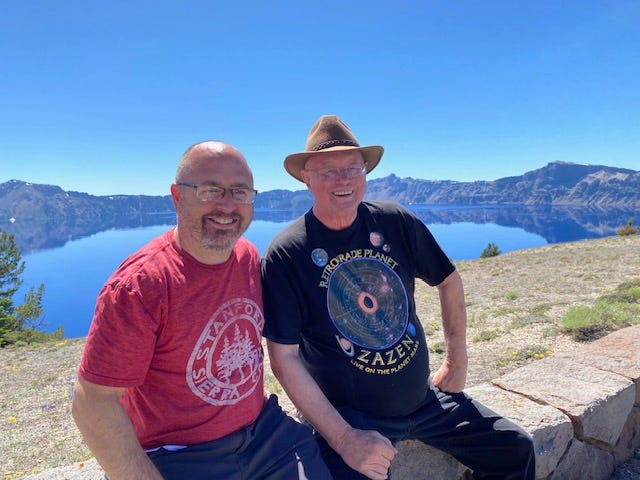
After several years of witnessing these incredible displays, I found myself getting caught up in the theater of the siddha powers and eventually the phenomena, as useful as it was as it broke open my world view, became another object of repetition and familiarity. Finally it only sustained my desire to want to see something more miraculous than the last time. I didn’t consciously know it but something else was calling.
Sometime later, sitting in my apartment in Portland, OR I was flipping through channels looking for something to watch on TV. Somewhere between Family Guy and The Food Network I stopped on a cable access channel as I saw a man with a beaming smile exuding the joy reminiscent of a small baby. I had to know for myself what was animating that ecstatic grin.
To me that smile represented true happiness and freedom and I left the world of magic behind.

That smile belongs to Eli Jaxon-Bear who is in the lineage of Ramana Maharshi, an Indian saint who spent many years sitting in silence in his holy mountain, Arunachala. Ramana had no teaching, only the direct transmission of silence and the invitation to dicover that what doesn’t come and go.
I attended several of Eli's retreats. But it wasn't until I returned from a retreat led by Eli and Gangaji in Lucknow, India — the home of their teacher Papaji — that something in me shifted completely. I came home knowing I couldn't keep working just to have a job. I emailed Eli and asked to work for him. A few months later, when a position opened, my partner and I moved to Ashland, OR, to work for the Leela School of Awakening where we have been for the last 12 years.
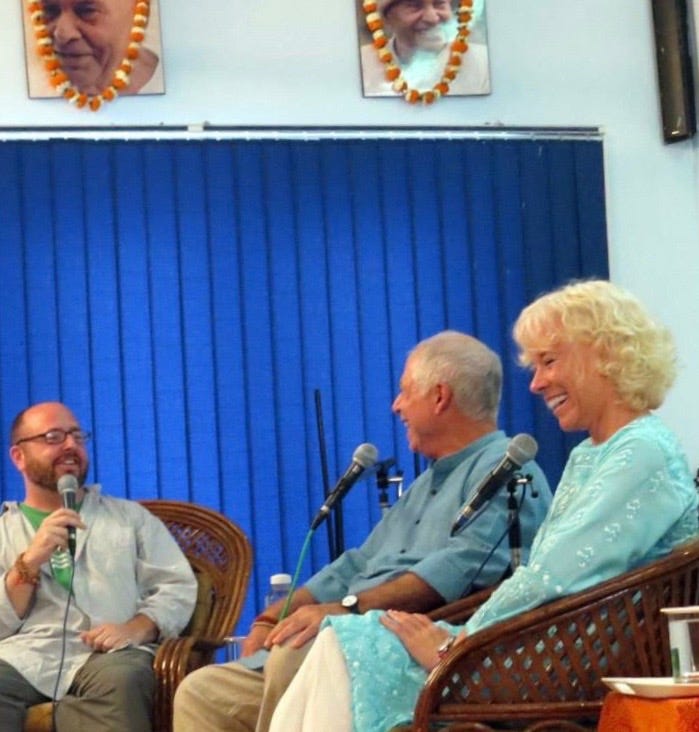
I knew before arriving in Ashland that in addition to offering Satsang, Eli also taught the enneagram, although I had no interest in it. I didn’t know anything about it and it just seemed like a distraction to me. I equated it to something similar to the Myers-Briggs assessment test. But a big part of my job was filming Eli’s retreats so whether I wanted to or not, I was immersing myself in the enneagram.
My first real lesson in how fixations work came when I almost got fired, about two years in. Not for being late. Not for missed deadlines. Not for attitude or incompetence. What I didn’t know was that what was running beneath the surface was a hard No.
No, I don’t want to do that. No, I shouldn’t have to.
This “No” was buried under the presentation of “Sure, I don’t mind.” It lived beneath a calm, easygoing exterior. It was a held anger I had no idea was there — until it became glaringly obvious. And that anger became my lifeline.
“Don’t spiritualize getting washed downstream by calling it going with the flow.”
Eli Jaxon-Bear
This is the clarity and the gift of the enneagram. It shows us what is subconsciously running, an automated, predictable machinery that is either rooted in anger, fear or a deep sense of unlovability. It shows us not merely where we are suffering but how we are addicted to the suffering, to this perpetuation of the story of an inherently limited “me and mine.” For most of us, our lives are built around protecting, defending and prolonging this me. The wisdom and clarity of the enneagram shows us that me is ultimately nothing more than a thought form; but there is a true Me that is naturally fulfilled, causelessly happy and free.
The price of this freedom is our life and in that we get tested; through this mirror of self-reflection, we see very clearly where we choose the comfort of familiarity and repetition, where we choose the drive of survival over the possibility of true freedom, the invitation to be no one at all.
Back to my Junior High classroom
You could make the case that one is free to change seats and also free to sit at the same seat all year round. And that is absolutely true.
What the Enneagram offers is the possibility of self-reflection — the chance to ask: Is it open, free consciousness that's choosing? Or is it a limited self that feels safer in the back of the room, less likely to be called on? Or nestled among friends for comfort? Or perhaps front and center, where everyone can see how smart and attentive they are?
This precision of the enneagram requires us to be ruthlessly honest with ourselves. It is not a venue for fixing or improving but simply exposing everything to the light and opening to the ease and natural joy of being when there is no one left grasping, defending or protecting.
Wow Joey! I love seeing your writing. Clean, clear, true.
Joey I feel that same radiance in your pure and gentle eyes, and it deeply embraces me.